
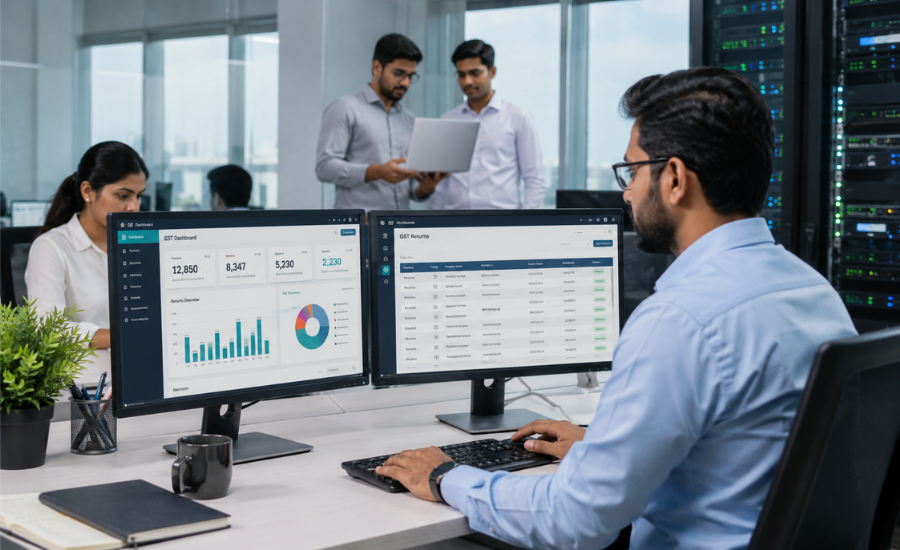
Advanced GST Data Management Software for compliance, reconciliation, reporting, automation, and secure enterprise operations.
Businesses across manufacturing, retail, healthcare, logistics, finance, wholesale, and eCommerce sectors rely on GST Data Management Software to streamline GST operations and improve enterprise productivity. These systems help organizations automate GST return preparation, manage reconciliation, track compliance status, generate reports, and monitor transactional activities in real time.

GST Data Management Software helps businesses organize, manage, monitor, and optimize GST-related information through centralized automation, intelligent reporting, reconciliation systems, and compliance management tools. Organizations handling invoices, tax filings, vendor records, purchase transactions, financial reports, and operational data require scalable software solutions to improve accuracy, reduce manual errors, and strengthen compliance workflows.
Modern GST Data Management Software integrates with ERP systems, accounting software, APIs, cloud infrastructure, and enterprise applications to simplify operational management and improve business visibility. Businesses can reduce compliance risks, improve audit readiness, and maintain secure business continuity through centralized GST data management frameworks.
Whether the objective is automating GST workflows, improving reconciliation accuracy, strengthening reporting systems, or optimizing enterprise tax management, scalable GST Data Management Software helps organizations maintain efficient, secure, and compliance-ready business operations.
Why GST Data Management Software is Important
Improves GST Compliance Management
Track filings, invoices, and tax-related activities accurately and efficiently.
Automates Enterprise Workflows
Reduce manual processes through automated reconciliation and reporting systems.
Enhances Financial Visibility
Generate real-time operational and financial insights through centralized dashboards.
Strengthens Data Accuracy
Minimize human errors within GST calculations, reporting, and filing workflows.
Improves Reconciliation Processes
Identify mismatches and discrepancies across invoices and tax records quickly.
Supports Secure Data Management
Protect enterprise GST information through secure storage and access controls.
Enhances Audit Readiness
Maintain organized and traceable GST records for operational audits.
Optimizes Operational Efficiency
Simplify enterprise GST operations and improve overall productivity.
Types of GST Data Management Software Solutions
- GST Reconciliation Management Solutions
Automate invoice matching and discrepancy management workflows. - GST Return Filing Solutions
Simplify GST return preparation, validation, and filing processes. - Cloud-Based GST Management Solutions
Manage enterprise GST operations across secure cloud infrastructure. - Vendor & Supplier Management Solutions
Monitor supplier compliance and transaction activities efficiently. - Compliance Monitoring Solutions
Track GST compliance status and operational risks in real time. - ERP & Accounting Integration Solutions
Connect GST workflows with ERP and accounting software platforms. - Dashboard & Reporting Solutions
Generate intelligent dashboards and operational reports instantly. - API-Driven GST Management Solutions
Enable secure integrations through enterprise APIs and automation systems. - Industry-Specific GST Management Solutions
Customized GST management frameworks for healthcare, finance, retail, logistics, and manufacturing sectors.
Key Features of GST Data Management Software
- Automated GST Reconciliation
Simplify invoice matching and discrepancy identification processes. - Real-Time Compliance Tracking
Monitor GST activities, filings, and operational compliance instantly. - Advanced Reporting Dashboards
Generate intelligent business reports and operational insights efficiently. - ERP & Accounting Integration
Connect securely with SAP, Oracle, Tally, Zoho Books, and QuickBooks platforms. - Role-Based Access Controls
Restrict access to sensitive enterprise and financial information securely. - Cloud-Based Infrastructure
Manage enterprise GST operations across distributed cloud environments. - Automated Validation Systems
Identify calculation errors and compliance risks proactively. - Audit Trail Management
Maintain operational logs and transaction histories for compliance tracking. - Secure Data Storage
Protect enterprise GST information using advanced security frameworks. - Scalable Enterprise Infrastructure
Support large transactional datasets and growing enterprise workloads.
Development Process
- Requirement Analysis
Understand business workflows, operational challenges, and compliance requirements. - Data Assessment & Planning
Analyze GST records, reporting needs, and reconciliation processes. - Software Architecture Design
Build scalable GST management infrastructure and workflow systems. - Dashboard & Reporting Framework Setup
Define reporting modules and enterprise analytics structures. - ERP & System Integration
Configure integrations with accounting systems and enterprise platforms. - Automation & Workflow Configuration
Implement automated reconciliation and compliance monitoring systems. - Security & Access Control Setup
Deploy authentication, permissions, and secure enterprise access management. - Testing & Optimization
Validate scalability, software performance, and operational accuracy. - Deployment & Monitoring
Launch GST management software with continuous monitoring support. - Maintenance & Technical Support
Provide ongoing optimization, updates, and operational assistance services.
Technology Stack for GST Data Management Software
- Backend Technologies: Node.js, Python, Java, PHP
- Frontend Technologies: React.js, Angular, Vue.js
- Database Systems: PostgreSQL, MongoDB, MySQL, Microsoft SQL Server
- Cloud Platforms: AWS, Microsoft Azure, Google Cloud Platform
- Analytics Technologies: Power BI, Tableau, Apache Spark
- Security Technologies: SSL/TLS protocols, encryption systems, authentication frameworks
- ERP & Accounting Integrations: SAP, Oracle, Tally, Zoho Books, QuickBooks
- API Technologies: REST APIs, GraphQL, secure webhooks
- Monitoring Tools: SIEM dashboards, audit monitoring systems, reporting platforms
- DevOps & Deployment: Docker, Kubernetes, CI/CD pipelines
Cost Factors of GST Data Management Software
The overall pricing depends on enterprise infrastructure complexity, software features, and operational scale.
- Volume of Enterprise Transactions
Large transactional datasets require scalable infrastructure and automation systems. - Software Feature Complexity
Advanced dashboards, reporting, and reconciliation modules increase implementation costs. - Cloud Infrastructure Requirements
Cloud-based deployment environments influence operational expenses. - ERP & Accounting Integrations
Enterprise system integrations impact development and deployment pricing. - Automation & Analytics Features
Intelligent monitoring and workflow automation systems contribute to implementation investments. - Compliance & Governance Requirements
Industry-specific reporting obligations affect project scope and operational costs. - Security & Access Control Systems
Advanced authentication and enterprise security frameworks influence infrastructure requirements. - Maintenance & Technical Support
Ongoing optimization, monitoring, and support contribute to recurring operational expenses.
Latest Trends
- AI-Powered GST Automation
Artificial intelligence improves reconciliation accuracy and compliance monitoring. - Cloud-Native GST Platforms
Businesses increasingly adopt scalable cloud-based GST management infrastructure. - Automated Invoice Matching
Intelligent systems simplify reconciliation and discrepancy detection processes. - Real-Time Compliance Monitoring
Businesses prioritize instant compliance tracking and operational reporting capabilities. - API-Driven Enterprise Integration
APIs improve secure connectivity between enterprise systems and GST platforms. - Advanced Business Intelligence Dashboards
Interactive dashboards improve operational visibility and enterprise decision-making. - Predictive GST Analytics
Businesses use predictive analytics to identify future compliance risks proactively. - Centralized Governance Frameworks
Unified platforms improve enterprise operational control and workflow management.
Why Choose Us for GST Data Management Software
Expertise in Enterprise GST Solutions
We provide scalable GST Data Management Software tailored to enterprise operational and compliance requirements.
Advanced Automation Infrastructure
Our systems improve workflow automation, reporting accuracy, and operational efficiency.
Intelligent Reconciliation & Reporting
We implement advanced software systems for reconciliation, reporting, and compliance management.
Seamless ERP & Accounting Integration
Our solutions integrate smoothly with leading ERP and accounting platforms.
Scalable Cloud-Based Solutions
Our infrastructure supports enterprise growth and large transactional datasets efficiently.
Automated Compliance Monitoring
We simplify GST compliance through intelligent dashboards and monitoring systems.
Industry-Focused Expertise
We support healthcare, finance, logistics, retail, manufacturing, and eCommerce industries.
Dedicated Technical Support
Our experts provide continuous optimization, monitoring, and enterprise operational assistance.
Ready to simplify your GST operations and enterprise compliance management?
Let’s build scalable GST Data Management Software tailored to your operational and reporting requirements.
Contact us today for a free consultation and customized quote.
GST Data Management Software is a solution that helps businesses manage GST-related records, automate reconciliation, monitor compliance, and generate operational reports efficiently.
Yes, modern solutions support integration with ERP, accounting, analytics, and enterprise software systems.
Automated reconciliation systems identify mismatches and discrepancies within invoices and transactional records quickly.
Yes, scalable solutions support cloud-based enterprise operations and distributed business environments.
Yes, scalable infrastructure supports enterprise-scale operations and large transactional datasets efficiently.
Healthcare, finance, logistics, retail, manufacturing, wholesale, and eCommerce sectors benefit significantly.